Memory Bliss
Participatory Spatial Installation, https://memory-bliss.jeron.org
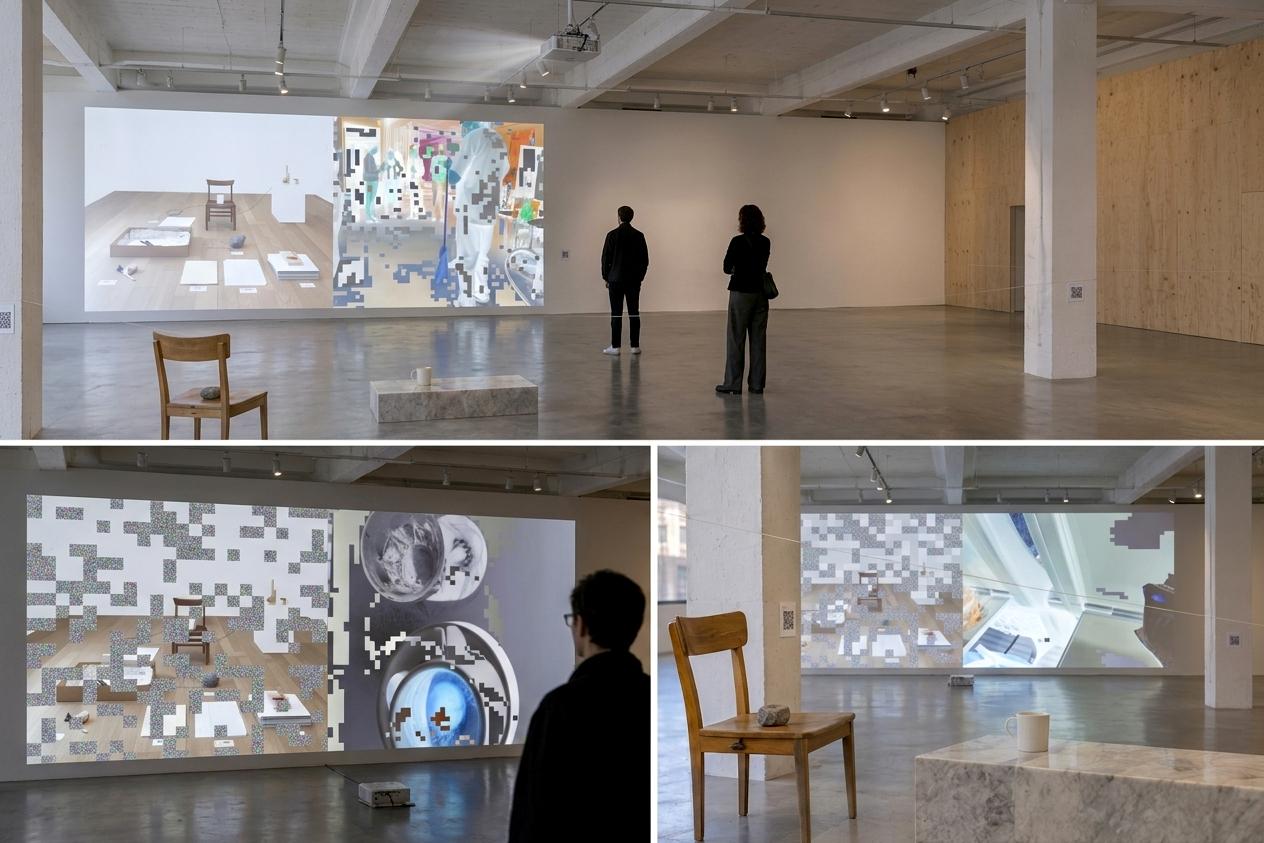
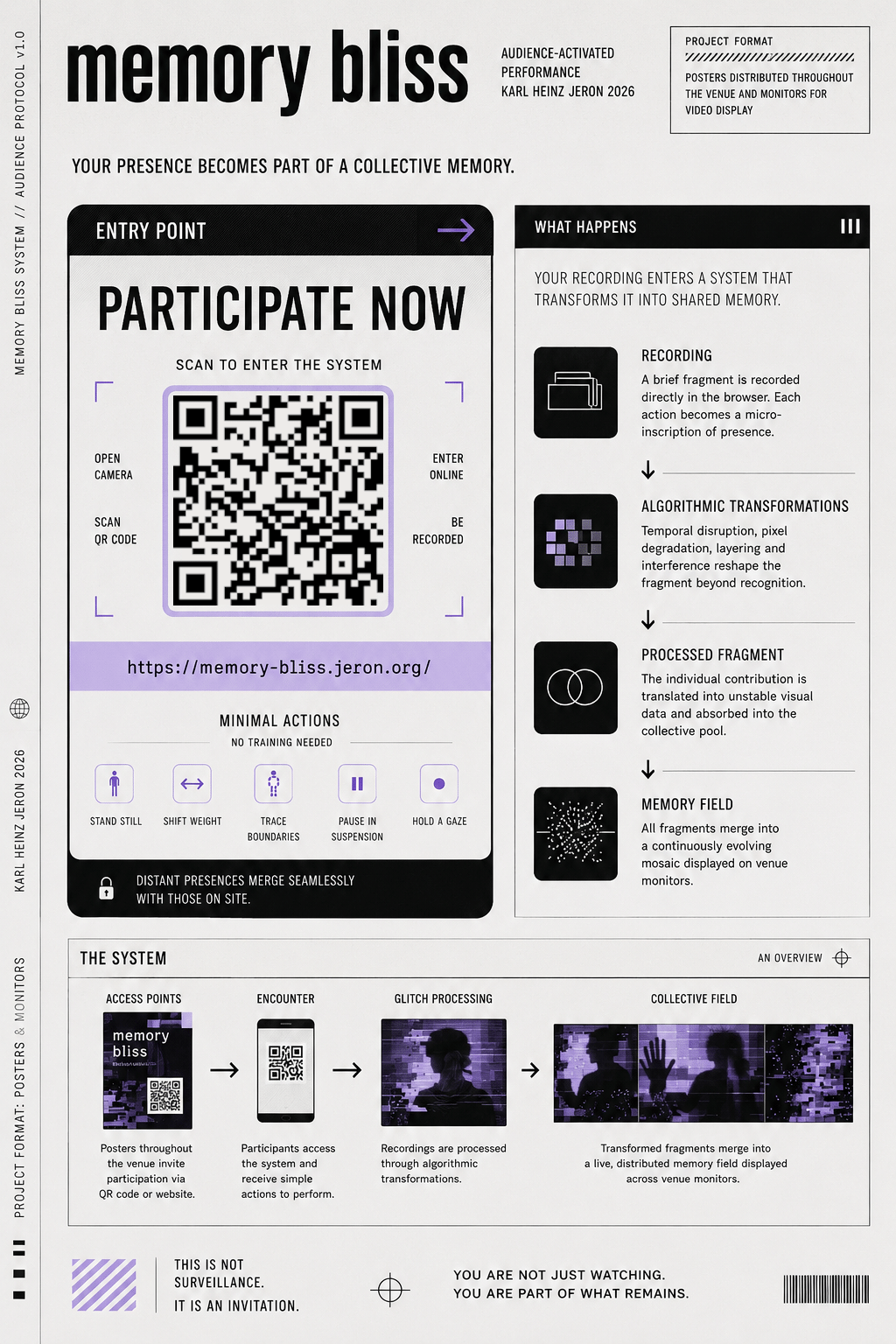
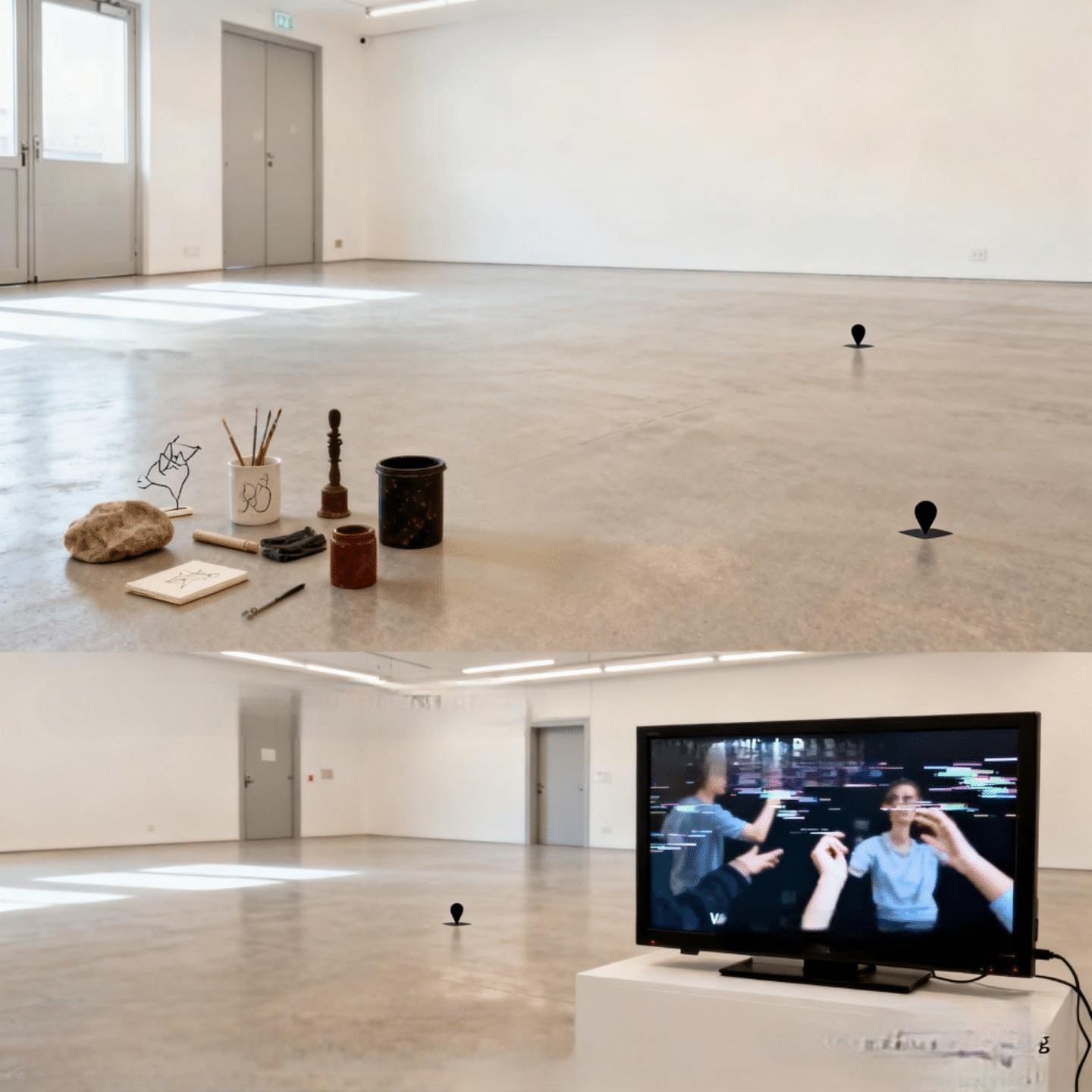
Memory Bliss is a site-specific participatory spatial installation spanning two exhibition levels. The work uses doors, thresholds, surfaces, stairwells, elevators, and lighting as elements of a spatial score. Small labels carrying brief instructions and QR codes are placed on architectural structures, everyday objects, and easily overlooked spots. The QR codes lead to a browser-based Glitch Recorder and to a continuously changing Video Pool. The work is conceived primarily as an on-site experience: the existing architecture determines where and how actions take place, and the digital layer connects them within a shared, temporally unstable image space. The arrangement is deliberately not a linear route. Visitors discover individual instructions, decide their own order, and determine the duration and intensity of their participation.
The work examines forgetting not as the counterpart to memory, but as a process that transforms memory, and it enacts this process rather than depicting it. Visitors perform short, self-determined gestures: they trace the shape of something lost in the air, place a stone on an empty chair, walk through a door and bring something back, or hold a cup as if it were full. Each action can enter the shared visual system as a video trace. A newly recorded gesture remains partially recognizable at first, then is shifted in time, fragmented, layered, and increasingly transformed. It can merge with other traces, disappear, and later resurface in altered form. The result is not an archive that preserves the past, but a system in which new traces alter the traces already present. Memory appears as something produced through selection, repetition, distortion, and loss.